A Construction Crew Uniform Case Study That Worked
- October 24, 2026
- 2:54 am
A construction superintendent does not need uniforms that look good only on delivery day. He needs shirts that hold their shape after repeated washes, outerwear that works through cold starts and changing weather, and clear branding that helps crews look organized when clients, inspectors, and subcontractors arrive on site.
This construction crew uniform case study follows a representative mid-sized contractor that needed to replace a loose collection of job-site apparel with a consistent program. The company had roughly 45 field employees, including foremen, equipment operators, laborers, service technicians, and project managers who moved between active sites. Its goal was straightforward: create a professional, durable uniform system without forcing every employee into the same garment year-round.
The result was not one shirt, one logo placement, and one bulk order. It was a practical apparel program built around the realities of construction work.
The Challenge: A Crew That Looked Like Separate Companies
Before the update, employees wore a mix of old company T-shirts, personal hoodies, faded safety-colored tops, and jackets from several different vendors. Some items carried an outdated logo. Others had no branding at all. The company name was technically visible on site, but not consistently enough to create a polished first impression.
There were operational issues as well. New hires often waited too long for apparel. Reorders were inconsistent because the office had no approved garment list, no standard logo file, and no reliable record of sizes. One employee might receive a lightweight cotton tee while another was issued a heavier work shirt from a different supplier. Color matching varied from order to order.
The contractor wanted a uniform program that could support three needs at once: visible brand presentation, job-site-ready durability, and easier administration for the operations team.
Building the Construction Crew Uniform Program
The first decision was to avoid treating every role and season the same. A single uniform solution may simplify purchasing, but it rarely serves a construction crew well. Field teams need layers, supervisors may need a more polished option for client meetings, and some locations may require high-visibility apparel or specific safety features.
The contractor created a core apparel system with approved options for warm weather, cold weather, and customer-facing work. This gave the team consistency without sacrificing comfort or job function.
A practical garment mix
For daily field work, the program centered on durable moisture-wicking T-shirts and long-sleeve shirts in company colors. These were selected for regular wear under hoodies, work jackets, and safety vests. Long sleeves gave employees an option for cooler mornings and extra coverage without adding the bulk of outerwear.
Midweight hooded sweatshirts became the primary layer for fall, winter, and early spring. A heavier workwear-style jacket was added for supervisors, foremen, and crew members routinely exposed to cold or wet conditions. The program also included structured caps for sun protection and a consistent, visible company identity.
Project managers received embroidered polos and outerwear in the same color family. This created a more refined look for walkthroughs, client meetings, and site visits while still connecting them visually to the field crew.
The key was not choosing the most expensive garment in every category. It was selecting dependable pieces that matched the job, held decoration well, and could be reordered later without rebuilding the program from scratch.
Choosing decoration that could handle the work
The contractor used screen printing for high-volume T-shirts and long-sleeve shirts. A bold, simplified left-chest logo was easy to identify from a distance, while a larger back print improved visibility around the job site. Screen printing made sense because these pieces were ordered in larger quantities and needed a clean, durable design that could stand up to repeated laundering.
For polos, jackets, and caps, embroidery was the stronger choice. Embroidered logos give structured apparel a finished, premium appearance, particularly when employees meet with clients or represent the company away from the job site. The logo was digitized once, reviewed through a digital proof, and retained for future production consistency.
There is a trade-off here. Large embroidered designs can feel heavy on lightweight garments, and fine logo details may not reproduce cleanly at a small size. The contractor simplified its logo for apparel use rather than trying to force every line of the original artwork into the decoration. That decision improved readability and produced a cleaner finished result.
What Changed After the Rollout
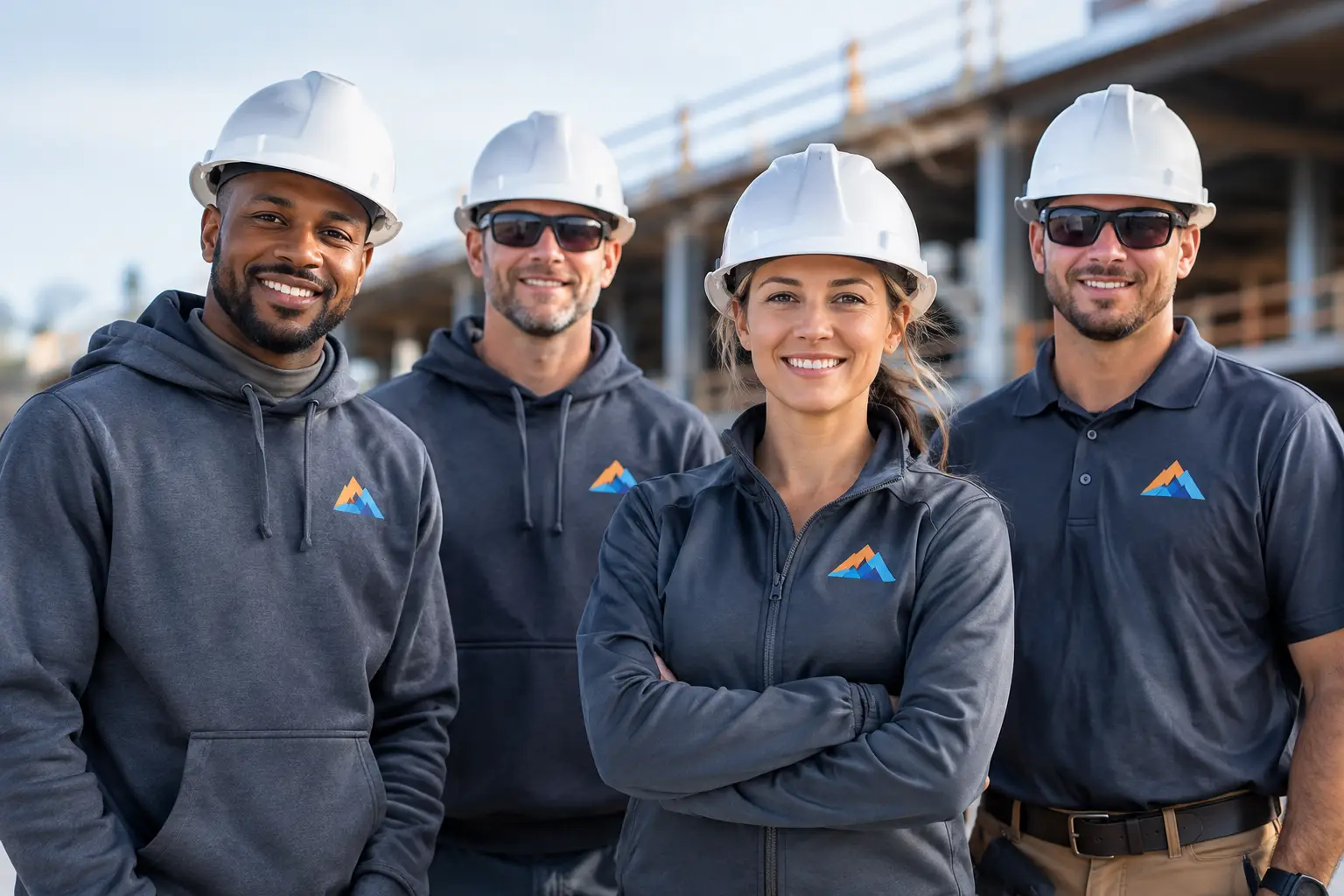
The most immediate change was visual. Crews arriving at a new site looked coordinated, recognizable, and prepared. The company name was visible on shirts, layers, and headwear, making it easier for clients and visitors to identify who belonged to the contractor’s team.
That visibility also supported day-to-day operations. Foremen could identify employees more quickly on larger sites. New hires received the same approved apparel as established team members. When crews worked alongside multiple subcontractors, a consistent uniform helped reinforce the contractor’s presence and professionalism.
The office team saw a benefit that mattered just as much: ordering became predictable. Instead of starting from zero with every request, the administrator had an approved garment list, logo placement standards, thread colors, print colors, and a size history for repeat orders. A new employee order could be assembled from the existing program rather than becoming a fresh sourcing project.
Why the Program Stayed Consistent
The contractor did not achieve consistency simply by placing one large order. It maintained consistency by setting clear standards before the first order was produced.
The approved collection identified which garments could carry which decoration method. It also set the company color palette, logo locations, and acceptable substitutions if a style became unavailable. That prevented a common issue in corporate apparel programs: a reorder that looks almost right but does not match the pieces already in the field.
Sizing was handled with more care than the company had used in the past. Construction crews include employees with different fit preferences, and outerwear sizing is especially dependent on whether a garment will be worn over layers. Providing size samples or using a fit process before placing a larger order can reduce exchanges and help employees feel comfortable in the apparel they are expected to wear.
The contractor also separated essential issue items from optional extras. Every employee received core shirts and an outer layer appropriate to the season. Additional hoodies, caps, and upgraded jackets could be purchased or awarded through the company. This protected the uniform budget while giving employees some choice.
Lessons for Construction Businesses Ordering Uniforms
The strongest lesson from this construction crew uniform case study is that apparel performs better when it is treated as an operating tool, not a promotional giveaway. The right uniform program supports safety, employee comfort, brand recognition, and order control at the same time.
Start by identifying the work environment. Indoor finishing crews, road crews, concrete teams, service technicians, and commercial project managers do not necessarily need the same garments. Consider weather exposure, physical activity, client contact, safety requirements, and the frequency of washing before selecting products.
Next, keep the logo system simple. A well-positioned left-chest logo, a readable back print when appropriate, and consistent colors often make a stronger impression than a complicated design. Decoration should be chosen for the garment and the intended use, not just for the initial price.
Finally, plan for the second and tenth order before placing the first one. A uniform program only saves time when approved styles, decoration details, and artwork are organized for repeat production. Working with a production partner that can manage embroidery, screen printing, proofs, and ongoing orders from one place removes many of the variables that cause inconsistency.
For construction companies, professional uniforms are not about making a job site feel corporate. They are about giving hardworking crews apparel that represents the quality of their work, holds up to the conditions, and makes every team member easy to recognize when it counts.
Popular Blogs
Richardson Caps for Professional Team Branding
October 22, 2026